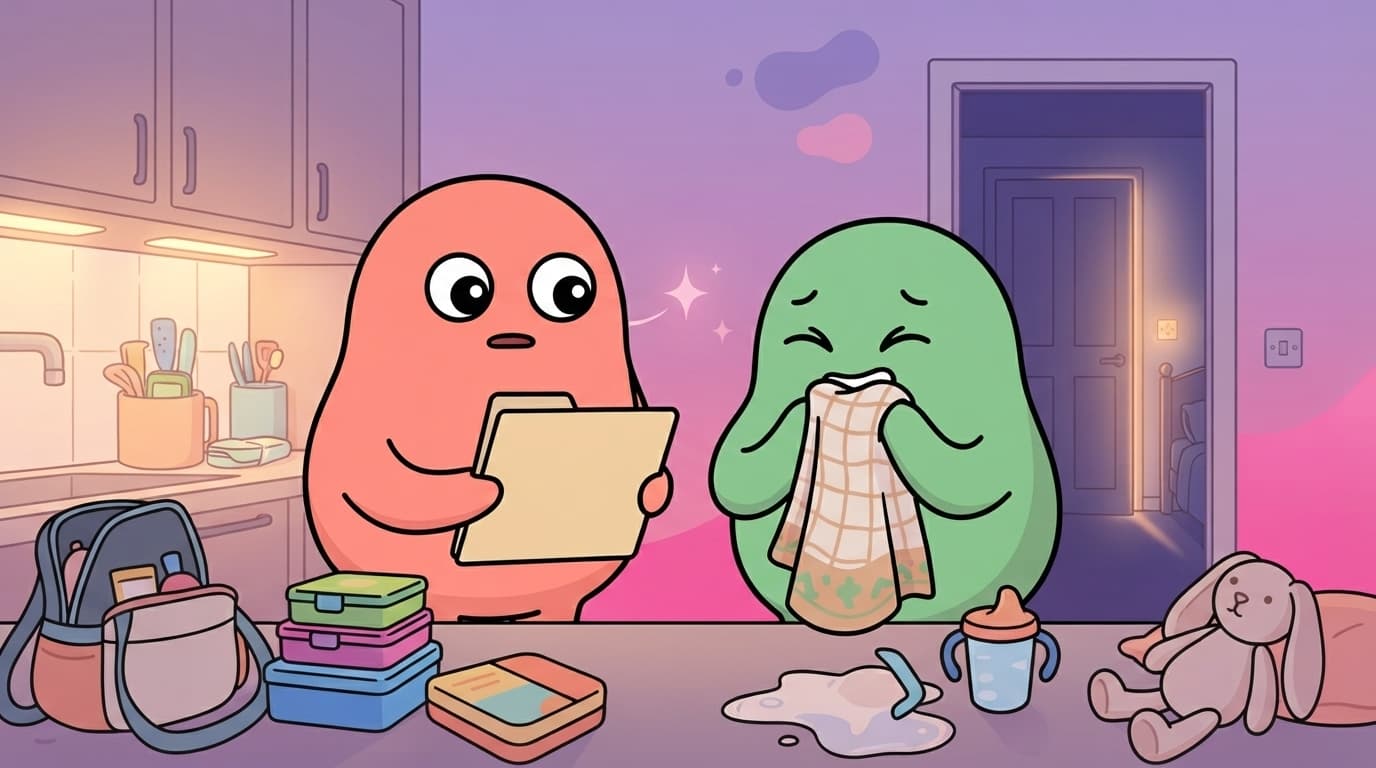
You used to spell things out. S-E-X, over their heads, very sophisticated. Now there's a preschooler who repeats everything at kinder, a toddler who appears in the doorway at 9:40pm holding one sock, and the two of you are reduced to eyebrows across the dinner table that nobody, including each other, can actually read.
And if you're honest, the eyebrows aren't really about the kids. It's been a while. Somewhere between night feeds and daycare germs you got out of practice, and now asking at all feels weird, like it needs a speech about how long it's been. Nobody wants to give that speech over fish fingers.
That's the job a code word does. Good code words for sex with kids around are boring on purpose: household admin, a fake errand or a friend who doesn't exist. Build one small set that covers four jobs (asking, yes, not tonight and later, after bedtime). Then check each line would sound like nothing if your three-year-old shouted it at grandma's. Dull is uncrackable, and dull is easy to say out loud.
Why does asking feel so weird now?
Partly because the house has ears, and they're about knee height. Little kids are tiny parrots with zero discretion. (Older kids are worse: they'll absolutely ask why you just said "Netflix?" in that voice.)
But mostly because you're measuring yourselves against before. It used to just happen: you'd look at each other and that was that. Next to that memory, planning it feels like admitting something's gone.
Karen Gurney, a clinical psychologist and psychosexologist who writes a lot about sex after kids, makes the point that desire is contextual. Back then the context did the heavy lifting: time, privacy, sleep, nobody calling out for a drink of water. "It used to just happen" was never really spontaneous. It was well supported. Take the support away and of course it stops turning up on its own. That's not the two of you running out of anything, it's a full house. Building a bit of context back on purpose is the grown-up move, not the sad one, whether that's guarding a small pocket of privacy when the kids are always around or a code word to book it.
How do we even suggest having a code word?
This is the scary bit, so keep it tiny. Skip how long it's been and open with the eyebrows, because you've both noticed them:
"We keep doing the eyebrow thing and neither of us can read it. Should we have a boring word for it, like 'the tax stuff'?"
It lands as a joke you're in on together, not a sit-down. If you're both laughing about whether "Steve" is a believable friend, you've already done the hard part.
So what code words for sex with kids around do we actually say?
The trick: pick one boring prop and hang all four jobs off it. No phrasebook to remember, and "no" and "later" sound exactly as dull as "yes."
| The job | Theme: "the tax stuff" | Theme: a friend called Steve (there is no Steve) | Theme: the good crackers |
|---|
| Asking | "Are we doing the tax stuff tonight?" | "Did you ever call Steve back?" | "Have we still got any of the good crackers?" |
| Yes | "I'll grab the folder." | "Yep, Steve's free tonight." | "Hidden at the back. I'll get them out." |
| Not tonight | "Tax stuff can wait." | "Steve's busy tonight." | "None left, sorry." |
| Later, after bedtime | "Tax stuff once they're down." | "I'll ring Steve after bath time." | "Crackers once the little one's asleep." |
Steal one, or swap in your own: a parcel that's "still on its way", "the spreadsheet", "the gutters." (For the bigger picture on code words for sex and why so many couples end up with a private language, start there.)
And the deadpan is half the fun. There's something deeply flirty about your partner asking about crackers with a completely straight face while a toddler throws peas at you both.
How do we make sure the kids never crack it?
Run every candidate through these:
- The boredom test. Kids interrogate anything that sounds fun. Nobody, in the history of children, has ever followed up on "the tax stuff."
- The grandma test. If your preschooler repeats it, word for word, at Sunday lunch, it should get a blank look, not a raised eyebrow.
- No collisions. Don't pick something you genuinely need to say. If "did you put the bins out?" is your code, someone's getting a very confusing answer on bin night.
- No wink. No "Netflix", no "dessert", no peach anywhere near the shared iPad.
Does "not tonight" need a rain check?
No. "Tax stuff can wait." is a whole answer. It doesn't need a "maybe Saturday" stapled to it. If you both feel like naming another night, lovely, but a no is allowed to just be a no.
What the code changes is how it lands. A plain no across a kitchen can sting, even when it's only exhaustion talking. "Steve's busy tonight" says the same thing with a grin, so whoever asked hears tired, not a verdict on them. If you've both been quietly waiting for the other one to go first, that matters more than any phrase on the list.
Same goes for asking early. "Tax stuff tonight?" at 4pm can turn bath time and a negotiation about broccoli into a private countdown, the same daytime spark as sexting a partner you've been with for years. It's a question, not a booking. The 8pm answer can be different.
Okay, it's booked. Now what?
A code word is great at booking the evening, less great at deciding what to do with it when you're out of practice and nobody wants to suggest something new over the spaghetti.
That's where peek comes in. The ideas come from the cards, not from either of you, so there's nothing personal to turn down and nothing to explain. You each swipe privately, a match takes a yes or a maybe from both of you and a pass is never shown, which makes it a code of its own: nobody at the dinner table has a clue you just matched on something. And there are date nights in there too, so neither of you has to be the ideas person.
If one of you finds it first, keep the hand-over as low-key as the crackers: "I found this thing where we each swipe on our own phones. Want to try it after they're down?"
Key takeaways
- The best code words for sex with kids around are boring: admin, errands or a friend who doesn't exist.
- "It used to just happen" had a lot of help. Planning a little now isn't a sign anything's gone.
- Hang asking, yes, not tonight and later off one theme.
- A coded "not tonight" is a complete answer. No rain check required.
Your code's sorted. For what comes after the dishwasher's on, download peek on the App Store or Google Play.
Frequently asked questions
What's a good code word for sex when you have little kids?
Something so dull a preschooler wouldn't bother repeating it: "the tax stuff", a parcel that's still coming or a friend called Steve who doesn't exist. Little kids only chase exciting words.
Can kids figure out our code words?
Toddlers and preschoolers won't, though they might parrot one at the worst moment, so it has to sound like nothing. Older kids catch anything with a wink in it. Pure admin gets past everyone.
Is it normal to need a code word just to ask?
Completely. After kids, most of what made it easy (time, privacy, sleep) has gone, so asking can feel strangely formal. A silly shared word takes the formality out, and it's a lot easier than a talk about how long it's been.