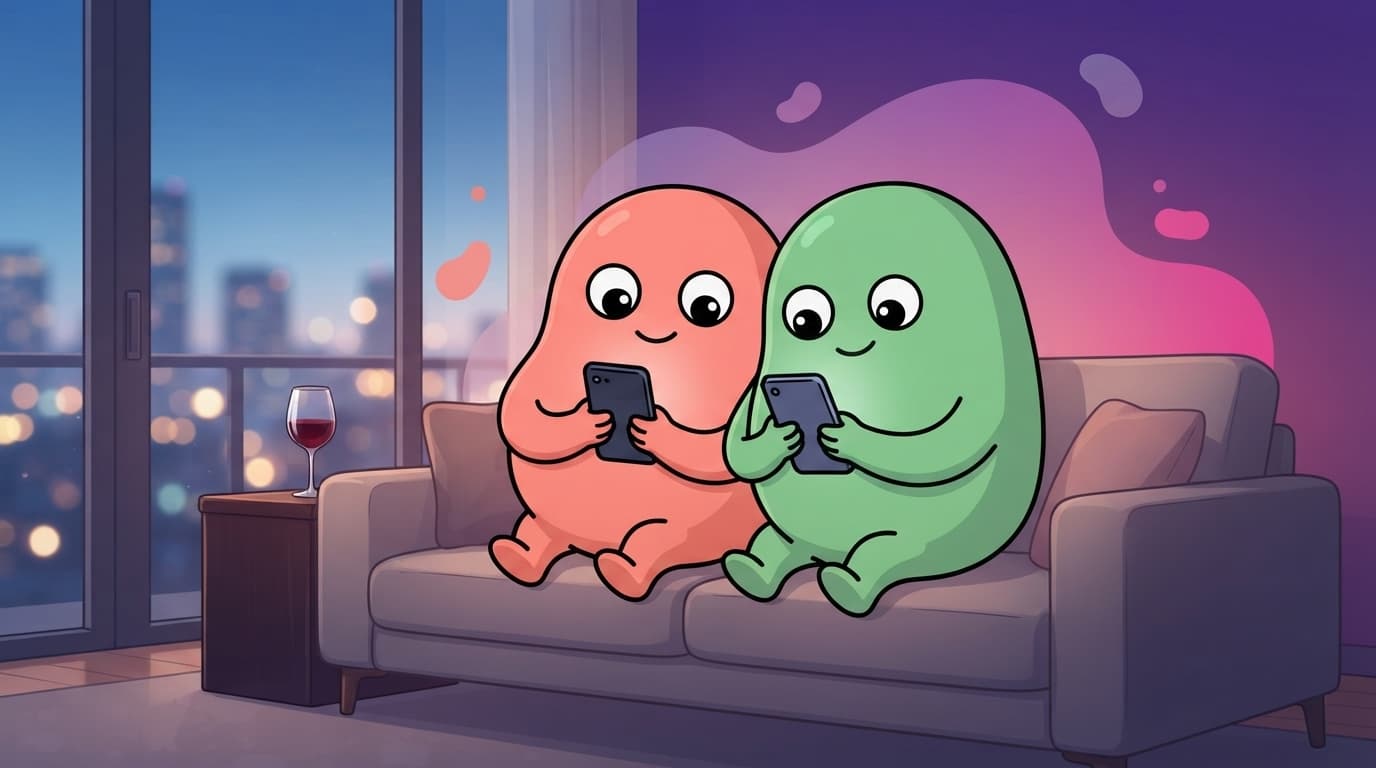
You two talk about everything. Money, therapy, your friends' terrible decisions, all of it. So it's a little funny that this one topic, what you actually want in bed these days, is the one that stays politely vague. You're not in crisis. You're good. You just have a quiet sense that things could be more alive than the same familiar script, and neither of you wants to be the one who makes it a thing. Fair. But before you'll be honest inside any app, you want to know exactly where that honesty goes.
So here's the honest answer: a good one is private, and it should be the first thing it tells you. With peek, your swipes are yours alone. Your partner never sees what you liked or skipped unless you both like the same card, and only that match ever surfaces. We collect only what's needed to run the app, we don't sell your data and you can delete your account whenever you want. So no, your sex life isn't sitting on a server for anyone to browse. The whole design starts from privacy, because privacy is the thing that lets you be honest in the first place.
What does a couples intimacy app actually store about me?
This is the right question to ask before you tap a single card, and the honest answer separates a trustworthy app from a sketchy one. Here's how peek handles it, plainly:
- Your swipes stay private until you match. Your partner cannot see what you liked, skipped or marked as a maybe. Nothing you react to is shared with them unless you both react the same way to the same card.
- Only matches surface. The only thing that ever becomes visible to the two of you together is a card you both said yes to. Everything else stays yours.
- We collect only what we need. peek gathers what's required to run the app and nothing more. There's no selling your data to anyone, ever.
- You can delete it all. Delete your account from the app or the website and it's gone for good. Full data deletion on request is a standing promise, not a hidden setting.
- It's not a dating app. No profiles to browse, no strangers, no syncing your contacts. The only person on the other end is the one you came in with.
The short version: the sensitive part, your actual preferences, is designed to stay locked to you until a mutual yes unlocks exactly one card. Not the pile. One.
Why does privacy matter so much for this, and not just legally?
Because privacy isn't only about data policy here. It's the thing that makes you tell the truth. The reason you've both stayed politely vague isn't that you don't trust each other, it's that saying a want out loud, first, into the open, is exposing. Somebody has to go first, and going first is where the risk lives.
Desire is quieter and more easily spooked than people admit. Pressure and the fear of a flat reaction are brakes, and few things stall a mood faster. Naming a new want risks the very safety you've built together, so the want goes unsaid and the same reliable script stays the same. That's not a communication failure. It's what happens when honesty has nowhere safe to land.
A private, simultaneous swipe takes that risk off the table. You each answer honestly on your own, and only a shared yes ever gets revealed. Nobody goes first, nobody gets rejected and the reveal is mutual or it's nothing. Clear the brakes like that and the accelerators get room to work: curiosity, novelty, the plain buzz of feeling wanted. That symmetry is also what lets whichever of you has been quietly sitting on "I miss when it felt like discovery" finally say it without it landing as pressure. Here's the part nobody tells you: it's a genuine thrill to find out you've both been quietly curious about the exact same thing, and neither of you had the nerve to say it first. If you want a gentler way to surface a want than reaching and hoping, there's a way in that doesn't put one of you on the spot.
How is this different from just texting each other what we want?
Texting feels private, but it's still one of you reaching and the other reacting, with everything you send sitting readable in a thread forever. The exposure is the same as saying it out loud, just typed. peek changes the structure, not the volume of nerve required:
| | Texting your wants | peek |
|---|---|---|
| Who goes first | One of you does, out loud | Neither, you both answer privately |
| What your partner sees | Everything you send | Only cards you both said yes to |
| Risk of a flat reaction | High, it's aimed right at them | Designed out, no match means nothing surfaces |
| Where it lives | A thread you both scroll back through | Your reactions stay yours until a match |
The point isn't that texting is bad. It's that texting still asks someone to be the exposed one. peek is built so the vulnerability is symmetric, which for a couple who've quietly drifted above the waist is usually the whole thing that's been stuck. And that drift doesn't need kids or a crisis to explain it. Two people who talk about everything else can let this one topic go soft, just from years of the same script and no easy way to say "what if we tried something new." The way back isn't a big talk. It's a handful of cards on a Tuesday and a shared yes you didn't have to be brave enough to ask for. If the same familiar routine is the part that's gone stale, breaking the script without overhauling everything is a soft place to start, and reopening things without sitting down for one big conversation covers the no-big-talk version in full.
Key takeaways
- A trustworthy couples intimacy app keeps your individual reactions private and surfaces only what you both agree on. That's exactly how peek is built.
- peek collects only what's needed to run, never sells your data and lets you delete your account fully at any time.
- Privacy isn't just a legal box. It's the condition that lets you be honest, because a private, simultaneous swipe removes the risk of going first.
- The vulnerability is symmetric: no match means nothing is revealed, so nobody is left exposed.
- This is not a dating app. No profiles, no strangers, no contact syncing.
Curiosity, not crisis, is the perfect reason to try it. If one of you is the type who hears about something smart and just downloads it, this is a low-stakes weekend yes. Grab peek on the App Store or Google Play and swipe through a few cards each. Nothing surfaces until you both want it to.
Frequently asked questions
Can my partner see what I swiped before we match?
No, and this is the part that matters most. Your swipes stay between you and the app until you both like the same card. Every skip, every maybe, every card you weren't ready to admit to out loud stays yours. Your partner only ever sees the ones you both said yes to.
Does peek sell my data or share it with advertisers?
No. We collect only what's needed to run the app, and your private list of wants isn't a product we'd ever sell. If you like to read the fine print before you trust something with the good stuff, it's all there in the privacy policy, spelled out plainly.
What happens to my data if I delete my account?
It's gone for good. Delete from the app or the delete-account page on the site, and full data deletion on request is a promise we keep, not a buried setting. Once it's done it's done, so have your moment of certainty first.
Is peek a dating app or hookup tool?
No. You're already with your person. No profiles to browse, no strangers, no swiping on people. It's just the two of you working out what you both quietly want.