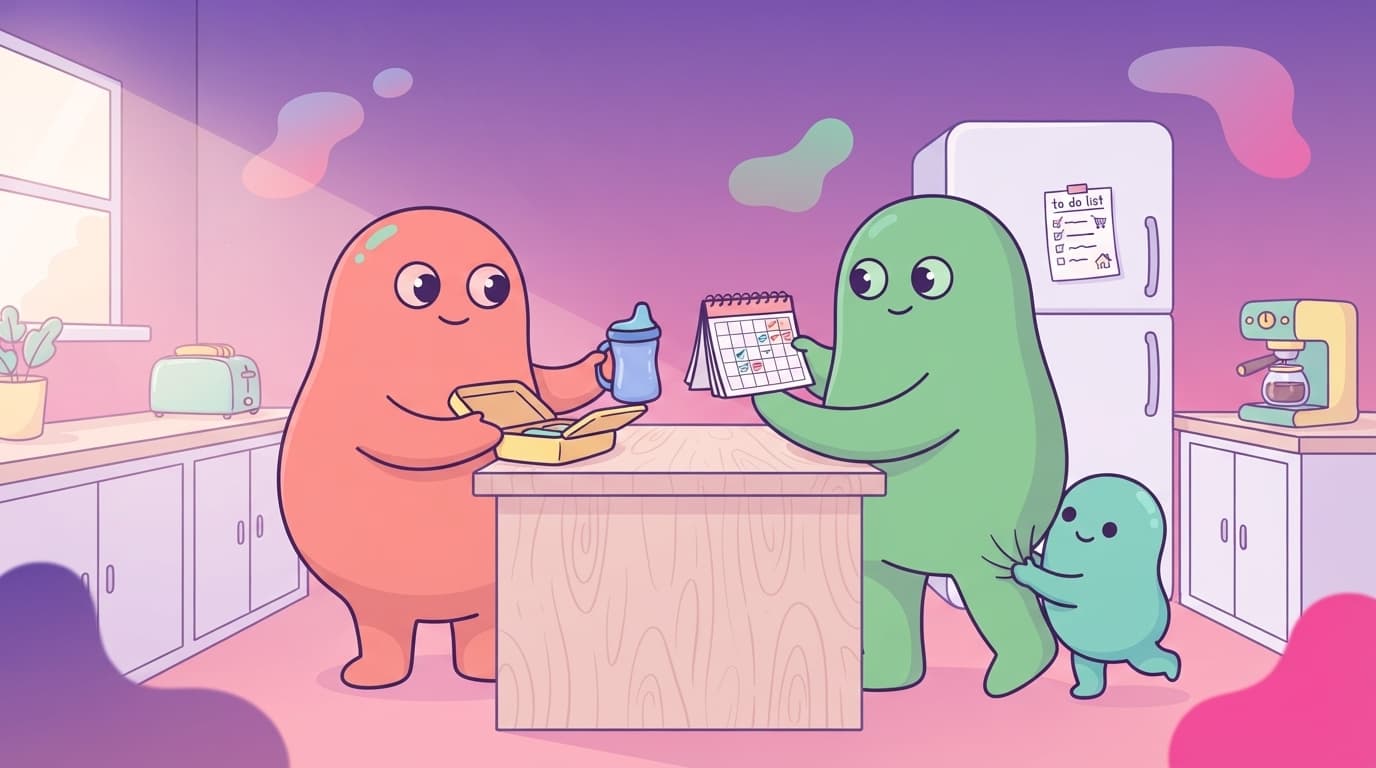
You've got the handover down to an art form. Sippy cup, lunchbox, the calendar synced without either of you saying a word out loud. You're a genuinely excellent team. And somewhere in the last year you clocked that you'd started talking to each other like colleagues who happen to share a bed.
Here's the actual answer, said plainly: that's not your relationship failing. It's what happens when two people get very good at running a household, and the couple part quietly clocks off while the co-parents clock in. The partners are still in there. They've just been pulling a long shift.
You're finally coming up for air. Sleep's back, work's back. And somewhere in all that competence you looked up and realised you talk more about who's doing the nursery run than anything that used to make you blush. Nobody warns you that you can love someone completely and still end up feeling more like excellent flatmates. If what you feel most is that you miss being close to your partner since the kids arrived, you're far from alone.
Why do we feel more like a parenting team than a couple?
Because you built a system, and the system works. Kids run on relentless logistics, so you both got fluent in a whole shared language of nap windows, packed lunches and calendar tetris. That fluency is a genuine achievement. It's also close to the exact opposite of what desire needs to breathe.
Here's the part nobody says out loud: the closeness that makes you a great team is the same closeness that can quietly flatten the spark. Desire likes a little distance and surprise, intimacy likes closeness and predictability, and the two are always leaning against each other. That's not a flaw in either of you, it's just how the two forces work. Co-parenting is a masterclass in closeness and predictability: you know exactly what your partner's doing next because you scheduled it together on Sunday night. Nothing kills a flutter faster than total operational transparency.
So this isn't a warning sign about the two of you. It's the completely normal side effect of getting really, really good at the parenting bit. The parenting team didn't replace the couple. It just booked out the whole calendar.
Is it normal to stop feeling like partners after kids?
Extremely normal. Being out of practice isn't a problem to solve, it's a phase almost every couple you know is quietly moving through too. The erotic side of things narrows hard during the baby years, and the habit of reaching for each other lapses while you're both just trying to get through the week.
Karen Gurney, a clinical psychologist and psychosexologist, points out that wanting someone has far more to do with the context you're in than some spark you either have or you don't. Change the context, even slightly, and it has somewhere new to show up. That reframes "I don't feel it anymore" into "we haven't built the conditions for it lately," which is a lot more hopeful and a lot more within your control. If restarting feels unfamiliar and a little awkward, that's not a bad sign, it's just the friction of picking something good back up after it's been paused. We wrote a longer, softer version of this in finding your way back to each other after kids.
How do we feel like a couple again without making it weird?
You go small. The instinct is to go big: a weekend away, a heart-to-heart sit-down, some grand gesture to make up for lost time. Skip all of it. Grand gestures are high-pressure and easy to flub when you're both knackered. The way back is tiny, low-stakes and a lot more fun than a sit-down talk.
Here's what actually shifts things, none of it requiring a babysitter:
- Turn toward the little bids. Those tiny everyday reaches for each other (a look, a joke, an "oh you have to see this") are the whole ballgame. Catch one and turn toward it instead of half-nodding at your phone.
- Trade a question, not a lecture. One curious question about your partner beats an hour of relationship admin. "What's something you've been wanting to try?" reopens the channel without turning into a whole debrief.
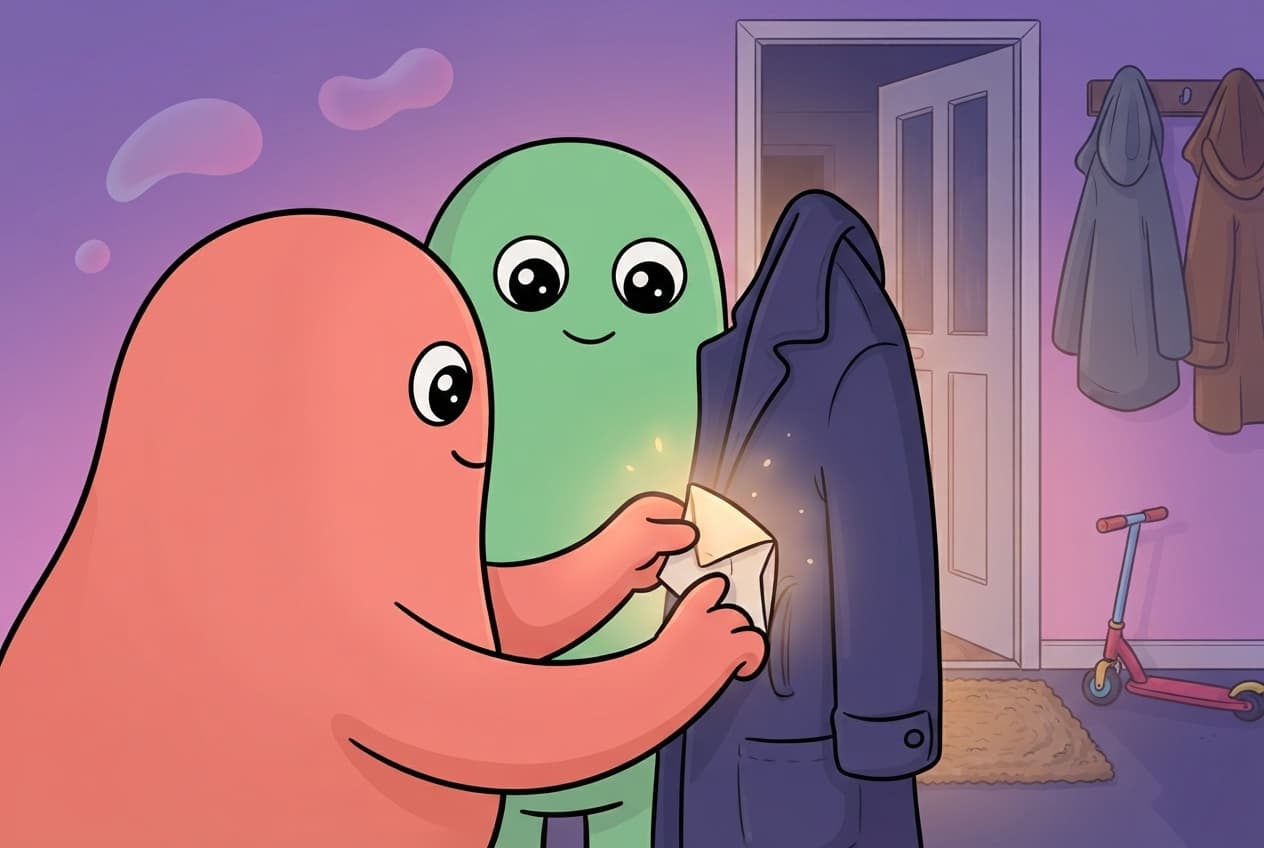
- Reintroduce a little mystery. Do one thing your partner can't predict from the shared calendar: a note in a coat pocket, a text that has nothing to do with childcare. A bit of the unknown is oxygen.
- Take turns being the curious one. Nobody should be the one carrying the whole restart alone. When it alternates, it stops feeling like a job and starts feeling like a game.
- Let something else hold the awkward opener. You don't have to manufacture the perfect vulnerable moment cold. A prompt, a card, a game can carry the first line so neither of you has to be brave solo.
That last one's the whole idea behind peek. It's the thing where you each swipe on your own phone, and the cards you both say yes or maybe to turn into a match you see together. Nobody has to go first, and that little reveal drops a bit of the missing mystery back into a relationship you otherwise know inside out. It's the couple channel, reopened, without a single scary conversation.
Key takeaways
- Feeling like parents not partners is a side effect of co-parenting well, not a sign your relationship's in trouble.
- Too much closeness and predictability can flatten desire: a little distance and surprise help more than extra effort does.
- Desire is contextual, not a spark you either have or don't (Karen Gurney): change the conditions and it has somewhere to reappear.
- Small turning-toward moments beat grand gestures, especially when you're both running on empty.
- Take turns being the curious one, and let a prompt carry the awkward opener so neither of you has to go first alone.
Being finally ready to close the gap is a genuinely lovely place to land, and you don't need to overhaul your life to get there. peek is a private, playful way to feel like a couple again after kids in the ten minutes you actually have tonight. Download peek on the App Store or Google Play and start with one card tonight. And if the physical side ever starts feeling loaded down the line, opening things up without it feeling like you're pleading is there for when you get there.
Frequently asked questions
Is it normal to feel like parents instead of partners?
Completely, and it tends to creep in right when things get easier, not harder. Plenty of couples only notice it once the survival years ease off and they finally have the spare attention to clock the gap. It's not a sign anything's wrong, it's just what the last few years asked of you catching up with you.
Does feeling like a parenting team mean we've fallen out of love?
Almost never. Love and desire run on different tracks: you can adore your partner and your teammate and still feel the spark go quiet, because closeness and predictability aren't the same as attraction. Reintroducing a little curiosity and surprise usually brings the couple feeling back without touching the love, which was never the problem.
How do we find our way back to each other when we're both exhausted?
Start absurdly small and low-effort. One question, one bid you turn toward, one card each on your own phones after the kids are down. You're not trying to schedule a passion project, you're just reopening the channel a crack. peek is built for exactly this: a few private minutes that don't ask either of you to be brave or perform.