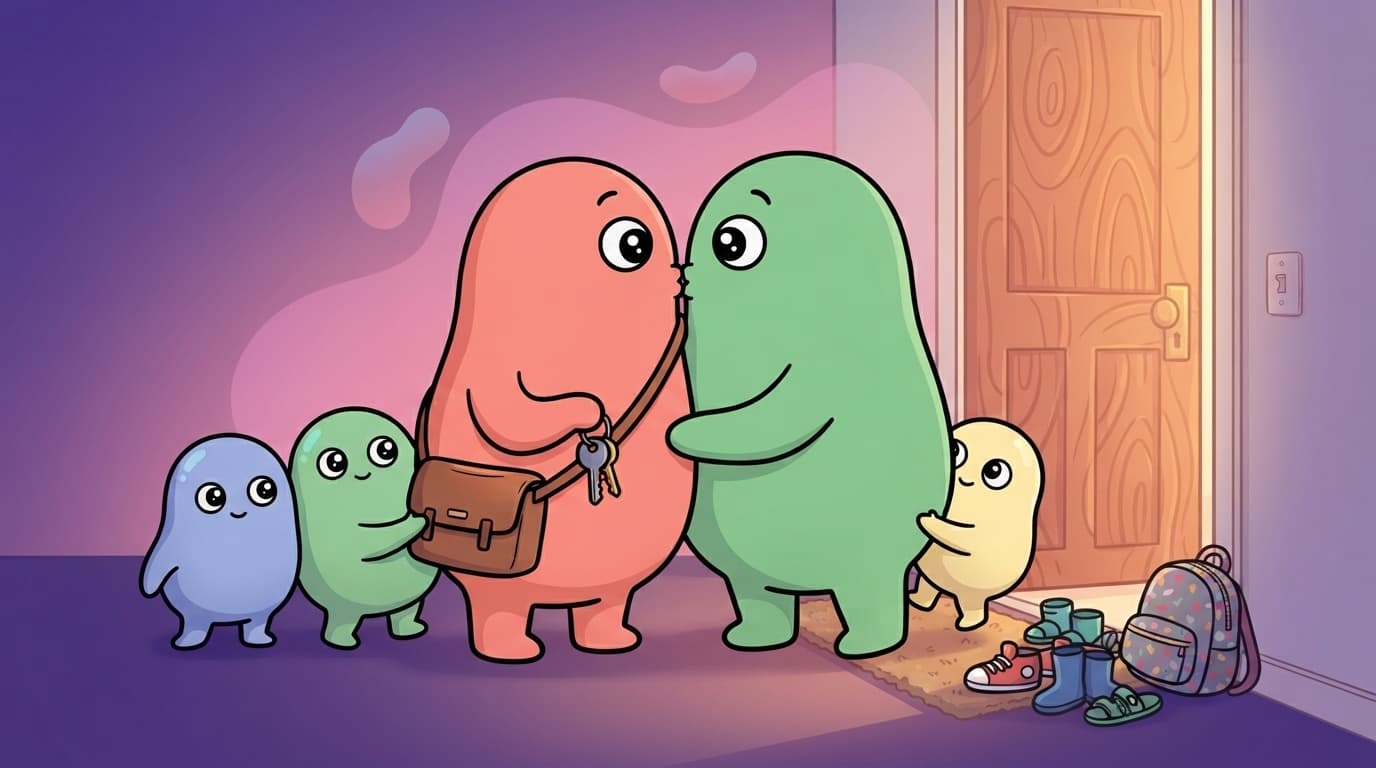
You know the kiss we mean: the one on the way out the door, aimed near the cheek, over before either of you registered it happened. You're a good team, the logistics are handled and somewhere in the last few years the kissing quietly turned into punctuation. This isn't a crisis. You're just out of practice.
So does the six-second kiss work? Yes, but not the way the internet sells it. It won't magically mend anything on its own, and it isn't a trick that ends in the bedroom every time. What it does is interrupt the peck-on-the-cheek autopilot most long-together couples slide into, and hold you in contact long enough to actually feel each other. It's one of the lowest-stakes moves toward closeness: the line between a goodbye and a real kiss.
What is the six-second kiss, and where does it come from?
It's exactly what it sounds like: you kiss your partner and hold it for six seconds. That's the whole instruction. The idea comes from John and Julie Gottman, relationship researchers at the Gottman Institute, and their real point isn't the seconds. It's that a kiss held past the reflex becomes a small deliberate turn toward each other, a daily bid for connection instead of a habit you barely clock. Not a full make-out. Just long enough to be a moment.
Six seconds sounds arbitrary. The number isn't magic. It's a threshold. A one-second kiss is logistics. Six seconds is long enough that you both have to stop and notice the other person is someone you fancy, not just the co-parent doing the nursery run. Around second three it stops being a task and starts being a kiss.
Does the six-second kiss actually work, or is it a gimmick?
The kiss itself isn't doing the heavy lifting. What's working is the thing underneath it, and that's real.
The thing that actually keeps couples close isn't grand romantic gestures. It's those small everyday turns toward each other, the little "hey, I see you" moments that either get met or sail past. Meet enough of them and the friendship stays warm and desire has somewhere to live. Miss enough and you drift, even when nothing's wrong. It's the pattern the Gottmans spent decades studying, and a six-second kiss is one of those turns, made deliberate. You can't do one by accident.
There's a second thing happening too, and it matters most for couples who feel more like excellent flatmates lately. Desire, for most of us in a long relationship, doesn't show up first and lead to touch. It's the other way round. The wanting arrives in response to closeness, a bit of novelty and the feeling of being wanted, not out of thin air. That's responsive desire: you don't wait to feel like it and then kiss, you kiss, you linger and the feeling catches up. Over-familiarity and a long day are the brakes here, and a longer kiss is one quiet way to lift your foot off them.
So does it work? It works as a door, not a switch. Some nights it's kissing for its own sake, and that's a win. Some nights it's the first domino. Either way you've told each other, without a word spoken about it, that you're still in this.
How do you actually do the six-second kiss without it feeling forced?
The most common worry, especially when you've been out of practice, is that a scheduled kiss feels clinical. Deciding to kiss for six seconds is the least sexy sentence ever written. Do it anyway. The slight awkwardness is the toll, and it's cheap.
A few ways to make it land instead of clang:
- Pick a natural hinge in the day. Leaving for work, walking back in, the handover after the kids are down. Attaching it to a moment you already have beats manufacturing one.
- Don't announce it. No need to say "right, six seconds." Just hold the kiss a beat longer than usual and let them notice. The surprise is half the charm.
- Let it be a real kiss, not a pose. Hand on the jaw, actually look at them first. Six seconds of stiff pecking is worse than one good second.
- Don't tack a demand onto it. No knowing eyebrow, no "so… later?". The second it becomes a down payment on sex, the pressure creeps back in and kills the whole thing.
- Count in your head the first few times, then stop. The number is training wheels. Once your default kiss is warmer, you won't need it.
That "no demand attached" rule is the one people skip, and it's the important one. The kiss works precisely because nobody has to go first with anything scary. If you want to reach for each other again without the old who-goes-first tension, how to initiate sex without the pressure sits right next to this. And if the distance crept in during the baby years and you're only now surfacing, how to find each other again after kids is written for exactly this moment.
What if a six-second kiss just feels weird after so long?
Then it's working. Weird is what "out of practice" feels like from the inside. A kiss that used to be automatic now needs a tiny bit of nerve, and noticing that isn't a sign anything's wrong. It's a sign you both stopped doing a small thing and can start again just as easily.
Give it a week before you decide anything. The first one is always the most self-conscious and the fourth already feels like yours again. The awkwardness has a short shelf life.
Key takeaways
- A six-second kiss works as a deliberate move toward each other, not a magic trick. It interrupts autopilot and holds you in contact long enough to feel each other.
- The number isn't magic. It's just past the threshold where a kiss stops being a reflex and starts being a moment.
- It leans on something real: the small daily moves toward each other are what keep couples close, and for most long-term partners wanting follows closeness rather than leading it.
- Keep it demand-free. The moment it becomes a down payment on sex, the pressure that killed the spark comes straight back.
- Expect it to feel weird at first. Out of practice always does, and that fades faster than you think.
If a longer kiss on the way out the door reminded you how easy the small stuff can be, peek is the low-stakes way to keep it going: you each swipe privately and a card only becomes a match you explore together when you've both said yes or maybe, so nobody has to go first. Download peek on the App Store or Google Play and find your way back to each other one small yes at a time.
Frequently asked questions
How long should a six-second kiss actually last?
Six seconds, roughly, but don't stopwatch it. The point of the number is to get you past the one-second reflex peck into something you actually feel. Once your everyday kiss is warmer, you can drop the counting.
Is the six-second kiss really backed by science?
The kiss itself is a rule of thumb from the Gottmans at the Gottman Institute. What's genuinely evidence-based is the idea underneath it: that small regular turns toward each other keep couples close, and that for long-term partners desire tends to follow closeness rather than lead it.
Will a six-second kiss lead to sex?
Sometimes, not always, and that's fine. Treat it as a switch you're obligated to flip and you'll add pressure, which backfires. Treat it as a warm hello with no strings and the nights it leads somewhere feel like a bonus.
We're pretty out of practice. Is it too late to start this?
Not remotely. Out of practice just means the habit paused, not that it's gone. Start with one longer kiss at a natural point in the day, keep it demand-free and let it feel awkward at first. The strangeness usually wears off within a week.