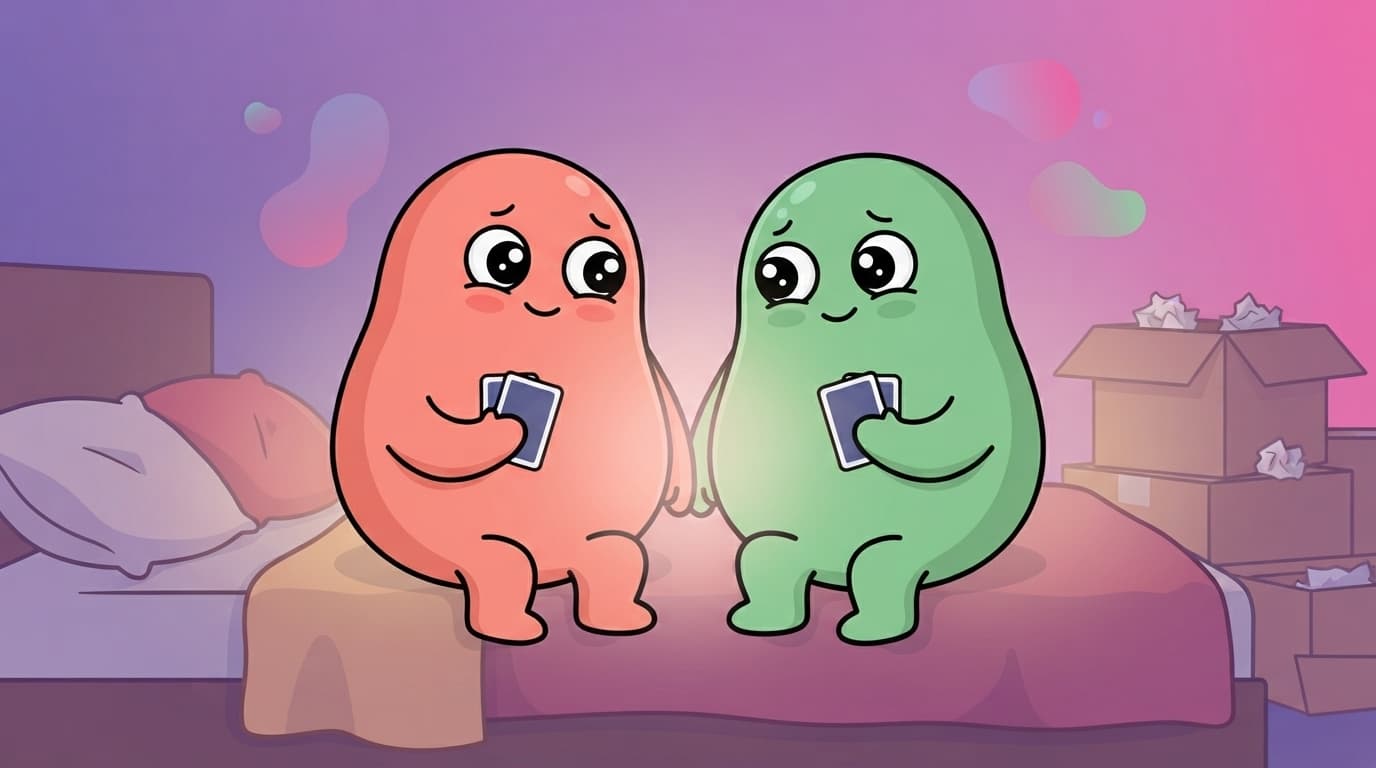
There's a fantasy you've half-thought about saying out loud, and every time you get close you picture it landing weird, your partner's face doing something you can't unsee, the two of you having to pretend the next ten minutes aren't happening. So it stays a thought. You two are good, the sex is fine when it happens, and you don't want to be the one who makes it strange.
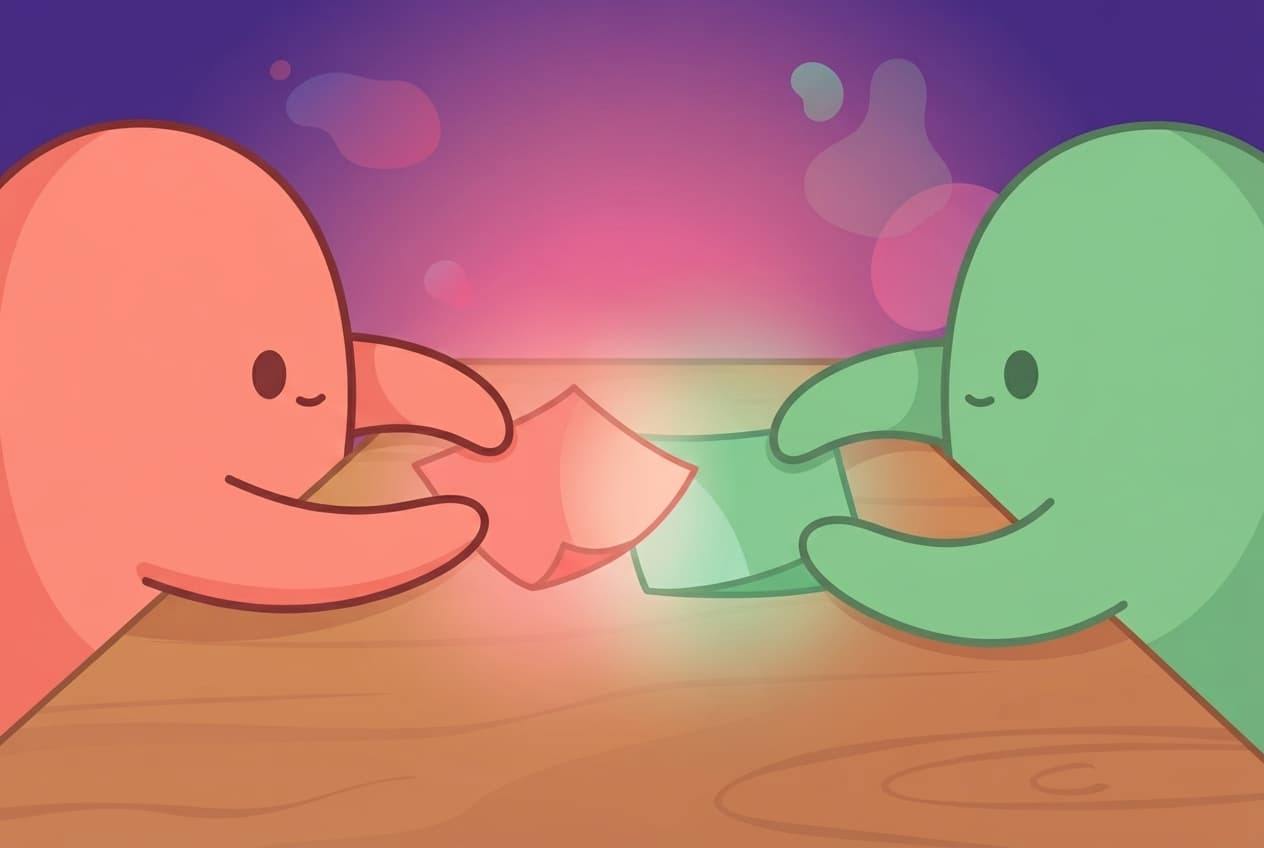
Here's the way through. To explore fantasies together as a couple without the awkwardness, take turns instead of making one person confess first, keep the sharing private until you both opt in and start with a light prompt rather than a big sit-down talk. Hint at what you're curious about, let your partner do the same on their own and see where you overlap. When you both land on the same thing, that's your green light. Nobody had to go first.
You can feel a script forming though, settling into the same shape at the same time. Neither of you has said anything because nothing's wrong and you'd rather not make it weird. That instinct to nudge it now, while the rhythm is still loose, is a good one. It's a lot simpler than unpicking a set one later.
How do we bring up a fantasy without making it a big deal?
You stop treating it like a confession and start treating it like a game. The reason "I want to tell you something" feels enormous is that it puts one person on a ledge, waiting to see the other's face. Take that away and the whole thing gets lighter.
Here's the shift that does most of the work: nobody goes first. When you both hint at what you're curious about separately, in private, there's no brave-person-jumps-off-the-diving-board moment. You each answer honestly for yourself, and the overlap is where the fun starts. No performance, no reading the room mid-sentence, no risk of watching someone's expression fall. It's the same low-stakes move behind reopening intimacy without a big conversation: you let a light prompt carry the opener so neither of you has to.
A few ways to keep it low-stakes:
- Trade, don't confess. One person naming a want and then waiting is exposure. Both of you naming wants at once is just play.
- Keep it private until you both opt in. You get to be curious about something without committing to it out loud. If it doesn't match, it stays yours.
- Start with a hint, not a monologue. A single playful prompt beats a sit-down talk. You can always say more once you know you're on the same page.
- Make it a question, not a critique. "What if we tried this" lands completely differently from "what we do now isn't enough." Same idea, opposite feeling, and it's the whole trick to saying what you want without sounding critical.
- Aim for discovery, not a verdict. You're finding out what you're both into, not grading the relationship. It's the same route couples years further in take to find out what a partner wants in bed after a long stretch of not asking.
Why does it feel riskier to ask now than it did at the start?
Because there's more to lose now, and that's not paranoia, it's math. In the first few months everything was new, so asking for something different cost nothing. There was no "usual" to contradict. Now there's a shared life, a shared rhythm and a version of "us" that works, so floating a new idea can feel like poking at something you'd rather not poke. If it helps, sex slowing down after year one is one of the most ordinary things a couple goes through, not a warning sign.
And here's the part worth holding onto. Jack Morin, a psychotherapist who studied how desire works, found that desire thrives on a bit of novelty, anticipation and mystery. Naming a fantasy adds the spark of the unknown, it isn't exposing something shameful, however kinky it feels. So the very fact that you two are settled and cosy is part of why a fresh idea feels both risky and kind of thrilling. You're not doing it wrong. You're just at the point where a bit of new gets invited in on purpose rather than showing up on its own.
Which is the reframe: wanting more, or wanting something different, isn't a complaint about your partner. Desire isn't a dial you're either stuck at or not, it responds to what's going on around you, a bit of play, a bit of surprise, the feeling of being wanted. Sharing a fantasy is just handing each other a bit more of that to respond to. It's an invitation, not a review.
What if we share a fantasy and it turns out we're not into the same things?
Then you've learned something useful and nobody got hurt, which is the whole point of doing it in private. Not every card is a match, and that's genuinely fine. If you hint at something and it doesn't land, it quietly stays yours. No awkward "oh… okay" moment, no one faking enthusiasm to spare the other's feelings.
That's the part that makes people brave. When there's no rejection to brace against, you'll both float things you'd never say out loud cold. And the non-matches aren't wasted either: they tell you something about each other. "Oh, so you're into that" becomes a reference point long before the same routine sets in, and it's a lot easier to learn now than to unpick a settled script later.
Key takeaways
- Exploring fantasies together stops being awkward the moment nobody has to go first. Take turns and share in private instead of confessing.
- Asking feels riskier once you're settled, and that's normal. Desire runs on a bit of novelty and anticipation, so something new gets invited in now rather than showing up on its own.
- Frame a fantasy as an invitation, not a critique. Wanting something different isn't a complaint about your partner.
- Non-matches aren't failures. They stay private and still teach you both something about what you're into.
- Start now while the script is still soft. Shaping it early beats unpicking a rut later.
peek is a private, playful place to explore fantasies together without the big talk. Because the prompt came from peek and not from either of you, there's nothing personal to reject and nobody has to say it out loud first. A card you both say yes or maybe to becomes a match you explore together, and a fresh weekly pack keeps handing you new things to be curious about. If you found this and you want an easy way in, download peek on the App Store or Google Play and try a pack together this week.
Frequently asked questions
How do I share a fantasy with my partner if I'm nervous?
Don't lead with the fantasy, lead with the format. Pick something that lets you both answer separately and privately, so you're not confessing into silence and watching for a reaction. When you find out you're on the same page, saying more feels easy. That's the part peek is built for: a card only becomes a match when you've both said yes or maybe, so the nerve-wracking part is designed out.
What if my partner isn't as into exploring as I am?
Pitch it as something fun to try this week, not as a "fix" for anything. A low-stakes format helps a lot here, because saying yes to a quick game is nothing like agreeing to a big talk about your sex life. Once someone's in and there's no pressure to perform, they usually engage more than they expected to. The trick is meeting them where they are instead of asking them to arrive somewhere first.
Is it normal for a new-ish couple to want to shake things up already?
Completely. Wanting to keep things fresh a year in isn't a red flag, it's you noticing a pattern forming and choosing to shape it while it's still easy. peek is a playful way to do that together, not therapy or medical advice, so if there's real distress underneath it a qualified professional in your area is always worth a call.