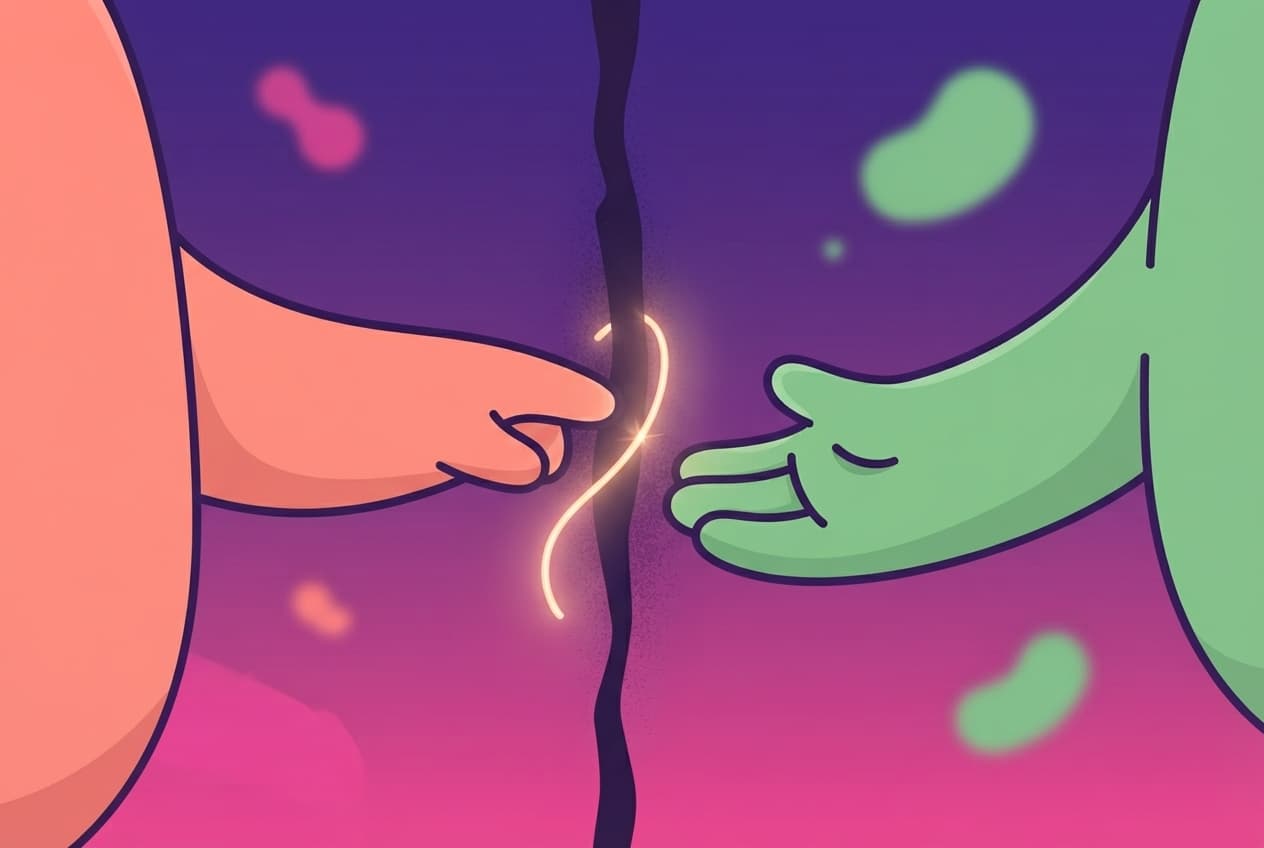
Nobody's said anything about last night yet. Maybe you're at opposite ends of the same couch this morning, coffee going cold, careful not to bump elbows. Maybe you're being weirdly cheerful over breakfast, which is its own kind of loud. Somebody reached last night and it didn't land the way they hoped. Now the quiet feels safer than trying again.
Here's the actual repair: you mend the connection first and leave the sex for later. The fight was never really about frequency or who did what. One of you felt unwanted. One of you felt pressured. Both of you felt alone in it. Naming that plainly, out loud and small, does more to bring you back than any apology about who was right.
If you love each other but the word that keeps coming up is roommates, and the rare time sex comes up it detonates the exact same way every time, this is for you. This can genuinely be different, and it doesn't start with getting the sex right. It starts with getting each other back.
Why do fights about sex hurt so much more than other fights?
Because they're never really about the sex. A fight about the dishwasher is a fight about the dishwasher. A fight about sex is a fight about whether you're still wanted, whether you're still enough, whether the person you built a life with still reaches for you. That's why it cuts so deep.
When you reach for your partner and it goes sideways, some quiet part of you stops asking "did we disagree" and starts asking "am I safe with this person." One of you hears "not tonight" as "you don't want me anymore." The other hears the ask as "you're failing, again." Both of you are asking the same terrified question underneath: are we okay. Neither of you gets an answer, so you both retreat and the silence confirms the worst. Sue Johnson, a clinical psychologist and the founder of emotionally focused therapy, has spent decades showing this is the real wound in these fights: two people feeling unmet and bracing, not a verdict on the relationship. The hurt isn't a sign you're doing it wrong. It's a sign the stakes are exactly as high as they feel.
How do we make up without pretending it didn't happen?
You go back and reach again, on purpose, after it went wrong the first time. Not a big tearful summit. A small, specific move that tells the two of you it's safe. Here's the difference between papering over it and actually mending it:
- Pretending it didn't happen looks like brisk normalcy the next morning: a peck on the cheek, coffee, logistics and a quiet agreement to never mention it. The rupture stays live underneath, so the next fight starts from here.
- Repairing it looks like naming the soft thing, once, without defending yourself: "I think you felt pressured, and I don't want it to feel like that for you." No big plan, no "so what does this mean for us."
- Relitigating it looks like reopening who said what and who's more to blame. This isn't repair, it's the fight again in a calmer voice. Leave the transcript alone.
The move that heals is the middle one. You're not solving the sex, you're telling your partner that the person they reached for, or failed to reach for, is still on their side. That's what lets the guard come down. If it's gone quiet since, coming back from a rough patch works the same way.
One more thing, because it matters here. The apology can't come with a bill attached. "I'm sorry" that secretly means "so are we having sex now" isn't repair. Your partner can smell it, and it reloads the exact pressure that blew up the conversation in the first place.
What do you actually say the morning after?
Keep it short and aim it at the feeling, not the facts. You're not writing a statement, you're handing them a way back in. A couple of lines that land:
- "Last night got away from us. I don't want you thinking I'm keeping score, because I'm not."
- "I miss you. Not even the sex, just you. Can we start there."
Notice neither one mentions sex, and neither one asks for anything. That's the point. You're re-establishing that reaching for each other is safe again, which is the whole foundation the sex was ever going to sit on. If you want the longer version of untangling that pressure loop, how to ask without the fear of rejection picks up exactly where this leaves off.
How do we talk about the sex again without it blowing up?
Later. Genuinely later, once the connection is warm again and not while the rupture is still smoking. Same if something isn't working for you in bed. And when you do, take the one thing that keeps detonating it off the table: the live, face to face ask where one of you exposes what you want and the other has to respond on the spot.
That in-the-moment ask is the pressure. It's why the same conversation about sex ends the same way every time, and why "just communicate more" is useless advice here. The trouble isn't that you haven't said it. It's that saying it face to face is exactly what loads the brakes and reopens the wound. Take that pressure off and there's room for the other half to come back: curiosity, a bit of play, the small thrill of finding out your partner is a yes.
This is where peek helps, and the reason it works is that the prompt comes from us, not from either of you, so there's nothing personal in it to reject. You each answer privately on your own phone, whenever you want, and you only ever find out where you already agree. Nobody has to go first and nobody gets turned down, because the reveal is only ever a yes you both already gave. If the friendship underneath all this feels thin too, our piece on what to do when the closeness quietly slipped away is worth a read, because the foundation has to come back before the spark can.
Key takeaways
- A fight about sex is almost never about sex. It's a fight about whether you're still wanted and still safe with each other.
- Make up by mending the bond first and leaving the sex for later. Say the honest thing once, without defending yourself or asking for anything back.
- Don't pretend it didn't happen and don't relitigate it. Reach again, small and specific, so the connection knows it's safe.
- Come back to the sex once things are warm again and take the live, on-the-spot ask off the table so it can't detonate the same way.
If that same conversation keeps failing you, peek gives you a different way in. You each swipe in private on your own phone, and a shared yes or maybe becomes something you explore together, so wanting comes back without anyone going first. Both of you get to answer for yourselves, on your own timing, with nobody standing there waiting on a yes. Download peek on the App Store or Google Play and let reaching for each other feel safe again.
Frequently asked questions
How long should we wait before bringing sex up again?
There's no clock. Wait until the connection between you actually feels warm again, not one second before. Trying to talk about sex while the wound's still open just reopens it. The signal isn't time passing, it's the ease coming back.
What if every talk about sex turns into the same fight?
Then stop making it a talk. The live conversation is the thing that keeps detonating it, because putting your wants on the table face to face is pure pressure for both of you. A tool like peek lets you each answer privately and only surface where you already agree.
Is it normal to feel this far apart and still love each other?
Completely. You can love someone all the way through and still end up feeling more like roommates than lovers. It's far more common than anyone admits at 9pm on the couch, and it's a pattern, not a verdict on the two of you.