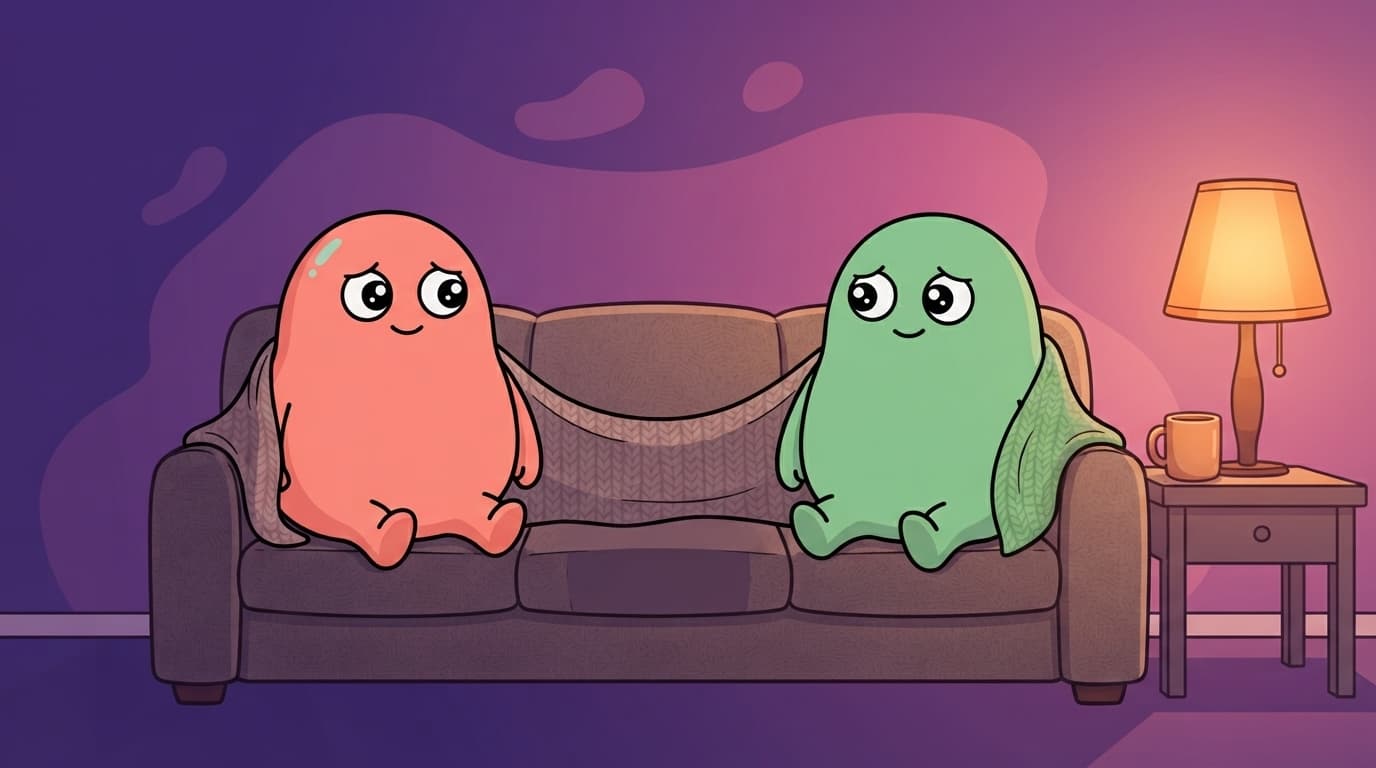
You love each other. You just haven't been lovers in a while, and after the rough patch it went quiet and the quiet stuck. You co-parent, you co-manage, you text about the shopping and somewhere in there the two of you started living more like excellent flatmates. Both of you have probably thought the word roommates and not said it out loud. Nobody's the villain. You're not withholding and they're not rejecting you. You just landed in a pattern, and a pattern is a smaller thing to shift than you're bracing for.
So here's the actual way back: you start smaller than a big talk, not bigger. When things go quiet, the instinct is to schedule one heavy sit-down meant to sort everything out, and it usually just reopens the ache. Skip it. Start with something low-stakes that lets you both show a little want without either of you going first or risking a no. You don't undo the quiet by talking harder at it. You soften it by giving it an easy, no-pressure way back in.
Why does everything go so quiet after a rough patch?
Because after a rough patch, reaching for each other feels risky, so you both quietly stop reaching. Sue Johnson, a clinical psychologist and the founder of emotionally focused therapy, has spent decades on this exact thing: when we feel safe with someone, we reach toward them without thinking about it, and when a hurt has dinged that safety, reaching starts to feel like showing a soft spot to someone who might not catch us. So you both pull back a little to stop the sting. You keep it light and logistical because logistics are safe, and every week you don't reach makes the next reach feel like a bigger deal.
The cruel part is that the quiet then becomes its own story. You read their tiredness as distance, they read your distance as coldness and neither of you is actually pulling away on purpose. Name that out loud to yourself and something loosens: this isn't proof you've fallen out of love. It's proof you both got a bit bruised and went quiet to protect it.
How do we get back to each other without another big talk?
You change the size of the ask. One big talk fails this exact moment because it asks two careful people to be maximally exposed at once, and exposure is the one thing a bruised bond can't do yet. So don't lead with words. Lead with a small, playful, private way to say "I still want you" that doesn't put either of you on the spot.
Here's why smaller works better than a summit:
- Nobody has to go first. When you both answer separately and privately, there's no exposed person waiting to be turned down. The risk that kept you careful is gone.
- It's not a scorecard. No quota, no "so are we doing this or not," no keeping track of who tried last. A quiet yes, not a performance.
- It's symmetrical. You each answer for yourselves, on your own terms, not in response to the other one asking. That's the difference between wanting and being asked to want.
- You only find out where you already agree. You surface the overlap, never the gaps. The first small yes you both land on is proof the spark didn't die, it went underground.
That last one matters most. After a rough patch, the thing you need isn't a plan, it's evidence that curiosity and attraction aren't gone. One shared yes does more for a quiet couple than an hour of earnest talking ever will.
But what if we've tried talking a hundred times and nothing changed?
Then stop trying to talk your way out of a thing that words keep making worse. If a big heavy talk worked, you'd have sorted this on attempt three. The reason it doesn't isn't that you're saying it wrong, it's that saying it out loud, from one of you to the other, is itself the pressure. And pressure is one of the heaviest brakes on desire there is: the harder you push the talk, the more you load the brakes and the further off wanting drifts.
There's also a quieter truth worth holding here: closeness and desire don't run on the same fuel. All that careful co-managing can make you feel like a tight, functional team and still leave zero room for the little spark of mystery that wanting needs. So the way back isn't only more closeness. It's a bit of surprise inside the closeness, a small "oh, you're into that?" that reminds you the person across the couch is still someone you get to discover, not just a co-pilot you manage the week with.
If part of what went quiet was that reaching for each other started to feel like asking for a favour, our guide to initiating without that lopsided, one-sided feeling walks through the same rejection-proof shift in more detail.
How do I even bring this up without it feeling like homework?
Here's the part you'll actually lie awake over: how to say "I found a thing" without your partner hearing "here's your assignment." The good news is the mechanism does most of the work for you. Try something like "no big talk, no pressure, we both tap through on our own and only see the stuff we're both into." That's the whole invitation, and it lands as a shared little game, not a summons and not your campaign, because the person on the other end never has to answer to you, only to the cards. Nothing to perform, nobody to disappoint and no verdict at the end.
Key takeaways
- After a rough patch, start smaller than a big talk. A heavy sit-down reopens the ache, a small low-stakes yes rebuilds the safety.
- The quiet usually isn't lost love, it's two people being careful at the same time so nobody gets hurt again.
- Pressure and the fear of a no are the brakes on desire. Take those off the table and wanting has room to come back.
- Answer separately and privately so nobody goes first, there's no scorecard and you only surface where you both already said yes.
- The first shared yes is the evidence you need: the spark went underground, it didn't die.
Getting back to each other after things went quiet doesn't have to start with a heavy talk you're both dreading. On peek you each swipe privately, and only the cards you both say yum to ever become a match, so nobody has to reach first and nobody gets turned down. If you want a softer way back, download peek on the App Store or Google Play and see where your first quiet yes lands.
Frequently asked questions
How long does it take to feel close again after a rough patch?
There's no clock on it, and honestly, watching the clock only makes it worse. What speeds it up is lowering the stakes so warmth has an easy way back in, rather than waiting to feel ready for one big talk. Small, regular, low-pressure moments do more than a single grand gesture.
We feel more like roommates than partners. Is that normal?
More common than anyone admits at 9pm on the couch. You can love someone completely and still drift into something that runs more like a well-managed household. It's a pattern, not a verdict, and it shifts once you give desire a bit of safety and a bit of surprise to work with.
What if one of us wants more than the other?
That's most long-term couples, and it's not a fault line. The trick is a setup where you each answer for yourselves, on your own terms, instead of one of you reacting to the other's request. When wanting isn't a demand, it stops feeling like pressure, and that's usually when the overlap starts showing up again. If the quiet followed a season of kids and exhaustion, our piece on finding your way back with a partner after kids covers that version of the drift.