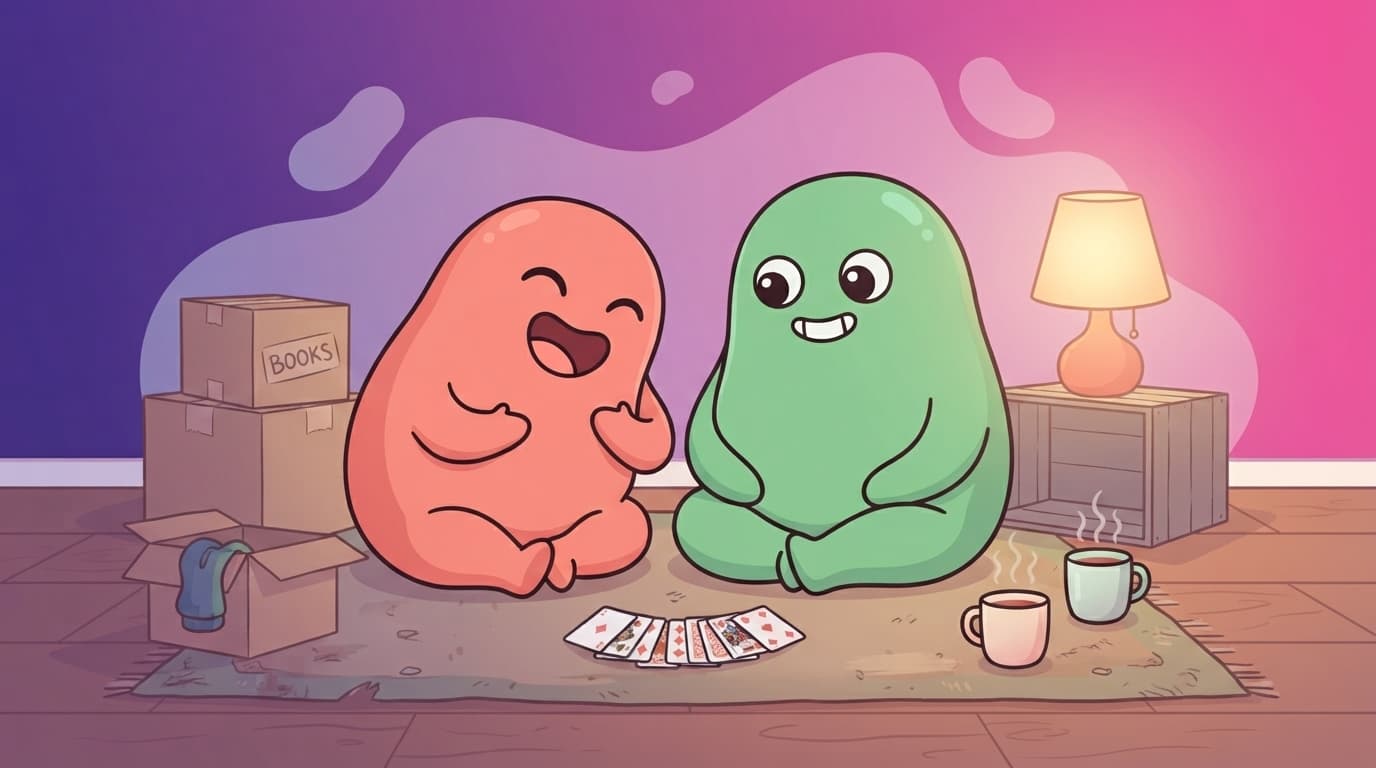
The nights you two laugh the hardest are still the daft ones. Some made-up game over dinner, a running bit that's been going for weeks, one of you doing the voice until the other properly cracks up. And somewhere in there you've thought, mostly to yourself, that you'd happily have more of this and a little less of the laundry rota.
Playing games together makes couples closer because play lowers the stakes on the stuff that's normally hard to say out loud. A game gives you a reason to be curious about each other, a way to ask without it sounding like a complaint and a little hit of novelty that plain routine doesn't. You end up learning things you'd never sit down and formally ask, and you're laughing while you do it. That's not filler. That's the closeness itself.
You know the season you're in. The honeymoon's settled, you've moved in together and things are genuinely good, just quieter than they were. You can see the faint outline of a rut forming and you'd rather not turn it into a whole big sit-down. And if one of you is reading this over the other's shoulder thinking "hang on, are we not okay?", you are, genuinely, nothing's wrong here. Nothing here is a "fix", because nothing's gone wrong. It's just the fun way to keep the good stuff good, no serious talk required.
Why does play bring couples closer than a serious talk?
Because a talk asks one of you to go first, be brave and name the thing, and that's exactly the part that feels heavier now than it did six months ago. A game hands the awkward opener to a card instead. Nobody has to be the one who brings it up.
There's a lovely idea from Peggy Kleinplatz, a clinical psychologist and sex therapist, that the couples who feel closest aren't the ones with the smoothest technique or the best lines. They're the ones who are genuinely present and a bit playful with each other, guard down, actually paying attention. Play is one of the quickest routes there. When you're mucking about, you stop performing and start being present, and presence is the thing that actually pulls two people together. The laughing isn't incidental either, which is why laughing together is good for your sex life and not just for the evening.
Play also does something a talk can't. A serious conversation about your relationship tends to circle what's already familiar. A game drops in a bit of surprise, and surprise is what keeps a settled couple from going flat, the same drip of novelty that stops sex settling into one routine. You want both, the warm familiar and the small unknown, and a game quietly smuggles in the second one.
What kinds of games actually make you feel closer?
Not the competitive ones, sorry. Nobody ever felt closer after watching their partner smugly win at Monopoly. The ones that pull you together are the ones where the whole point is finding out something new about each other. A few shapes that work:
- Question games. Trading questions you'd never think to ask each other over dinner. This is the easiest on-ramp, which is why so many couples reach for it first, and the best question games for couples all build gently from easy to bold so you never have to decide how far to go. You've lived with someone for months and still get a "wait, really?" out of them. That never gets old.
- This-or-that and preference games. Quick, low-stakes and sneakily revealing. Discovering you'd both secretly rather stay in and cancel the plans is its own tiny bonding moment.
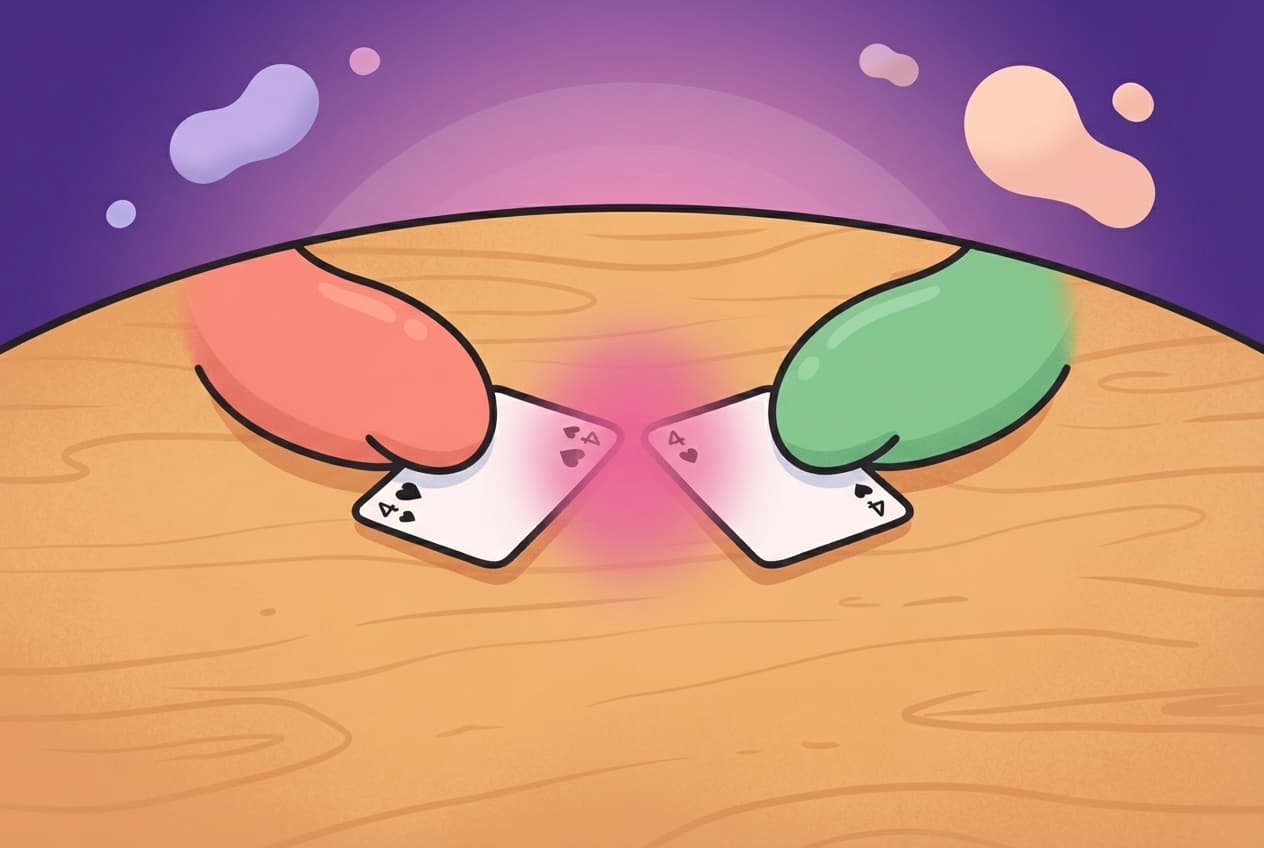
- Swipe or match games. You each answer privately, and only the overlap gets revealed. This is the format that takes the who-goes-first fear off the table entirely, which matters most for the stuff you're a little shy to say straight out.
- Desire and curiosity games. The spicier end, where you're mapping what you're both into without anyone having to make a speech about it. Nobody has to be brave first, the game does the brave part for you.
The through-line is the same across all of them: the game carries the vulnerability so you don't have to. You get the honesty of a big talk with almost none of the nerve it usually costs.
There's a bit of desire science tucked under that last one too. Novelty and a low-pressure setup are accelerators, the small things that make wanting easier to feel, and taking the who-goes-first fear off the table quietly lets off one of the brakes. A good game does both at once, which is more than a night of just trying harder usually manages. It's also a gentle counter to the way desire quietly slides down the list once normal life takes over, because you're tending to it a little at a time instead of waiting for it to come back on its own.
How do we say what we want without it sounding like a critique?
This is the real fear, isn't it. Early on, asking for something felt like nothing. Now there's more built between you, so "can we try it a different way" can land like "what we do isn't working," even when that's the last thing you mean.
A game sets the framing for you. When you're both answering the same prompt, wanting something new stops being a note about your partner and becomes a thing you're discovering together. There's no critique in it because nobody's being graded, and there's no right answer to get wrong. It's just two people saying "oh, I'd be into that" at the same time, which reads as an invitation, not a review.
And the nice thing is it's easy to keep going once it starts. A little regular play is one of the lightest habits a couple can have, the kind of thing you tend rather than schedule, and it fits neatly into ordinary life instead of demanding a weekend away from it.
Key takeaways
- Play makes couples closer because it lowers the stakes on the things that are hard to say directly, so honesty gets easier and the nerve gets smaller.
- Closeness comes from being genuinely present and playful with each other, not from performance or perfect technique, and a game is a fast route to that presence.
- The best games are the ones where the point is learning about each other, not winning.
- Answering the same prompt reframes "I want something new" as a shared discovery, not a note about your partner.
- A small play habit is one of the lightest, most fun ways to keep a good thing feeling new.
If you want the who-goes-first fear gone completely, that's the whole idea behind peek. It's a little game the two of you play on your own phones, and the ones you both say yes or maybe to become matches you explore together. Low-commitment enough to say yes to on a random Tuesday, honest enough to actually tell you something. If keeping the good stuff good sounds like your kind of easy, download peek on the App Store or Google Play and play a round this week.
Frequently asked questions
We're only a year in and things are good, do we really need this?
Good is exactly the moment for it. You're not patching anything up, you're just adding a fun little habit while things are easy and light. Think of it less as insurance and more as the good part of being a year in: you already like each other, so you may as well keep finding new reasons to.
How do I bring this to my partner without making it a big deal?
Pitch it as something fun to try, not a "fix", because it isn't one. "I found this thing, want to try it this week?" does the job. The whole appeal of a game is that saying yes is light. It's a round of cards on the couch, not a summit about your relationship.
Is peek therapy or a relationship program?
No. peek is a playful way to spark curiosity between the two of you, not therapy, counselling or a course to complete. If you ever want deeper support, someone qualified in your area is the right call, but for keeping a good thing playful, a bit of regular play is plenty.