You've finally come up for air. The baby years are mostly behind you, sleep is sort of back and one evening it hits you both that you can't remember the last time you felt like more than an excellent logistics team. You love each other. You're just a bit out of practice, and you don't want closeness to be the thing you quietly let slide now that you've got the room to notice it.
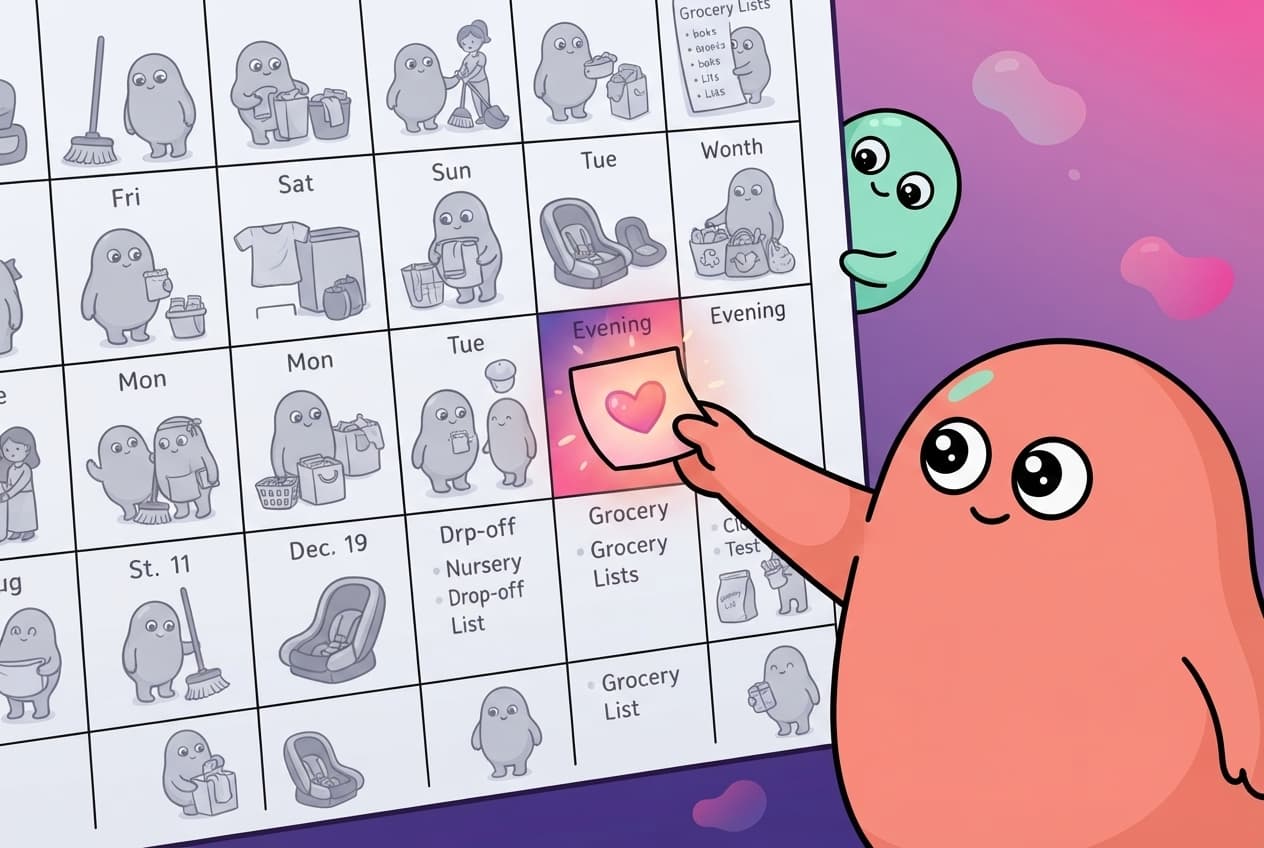
So here's the short version. Protect a small regular window (kids down, phones in another room) and then leave it gloriously empty. No performance owed, no box to tick. You're not scheduling sex, you're scheduling the space where wanting each other actually shows up. Put it on the calendar as "us, no agenda", aim for close and curious rather than a number you're hitting, and it stops feeling like homework and starts feeling like the good part of the day.
And to say it plainly: you're not lazy and you're not doing it wrong. You're tired and you're trying, and those are very different things.
Isn't scheduling intimacy the opposite of romantic?
It can be, if you book the wrong thing. There's a real gap between putting closeness on the calendar and putting sex on the calendar, and tired parents smush the two together without meaning to. The second "Thursday" quietly means "we're expected to perform on Thursday", the whole evening tenses up before it's even started. Pressure is a brake, and nobody wants to walk into a booking that already feels like an exam.
Karen Gurney, a clinical psychologist and psychosexologist, has a reframe that takes the edge right off this: desire is contextual, not some constant spark you've either got or you haven't. After kids, you stop waiting around to feel like it and start setting up the conditions for it instead, a bit of futureproofing rather than waiting to be struck by a mood that keeps missing the house. That flips the whole calendar thing on its head. You're not booking an obligation. You're guarding a soft little pocket of time where closeness has somewhere to land, which lifts your foot off the brake instead of piling on a demand. If the wanting hasn't come roaring back on its own even though life has calmed down, our piece on why desire doesn't just switch back on when things get easier sits right next to this.
So spontaneity is lovely and also mostly a myth once there are small people in the house. A protected, playful window beats waiting for a moment the nursery run keeps eating.
What makes intimacy feel like a chore, and how do we avoid it?
A chore has three ingredients: an obligation, an outcome you're graded on and one person lugging it around solo. Pull those out and the exact same slot on the calendar stops feeling like homework. Here's the difference in practice.
| Feels like a chore | Feels like making room |
| --- | --- |
| A slot that means "we should have sex tonight" | A slot that just means "us time, no agenda" |
| One person always initiates and organises | Both take part equally, nobody has to go first |
| Graded on frequency or performance | Measured by whether you felt close and curious |
| Big loaded "we need to talk about us" talk | A small, playful, low-stakes prompt |
| Squeeze it in when exhausted | A realistic window you can actually keep |
Lowering the stakes is only half of it though. Once the pressure's off, you get to add the good stuff back in: a bit of low-stakes play, the small thrill of something new instead of the usual and the quiet buzz of feeling wanted by the person who knows you best. That's the difference between clearing space and actually making intimacy fun again. Those are the accelerators, and a protected window is just where you make room for them. Our guide on reopening things without a big talk is all about starting that small.
We're both exhausted. Where do we even start?
Start with closeness. Not the bedroom, and honestly, start almost embarrassingly small. When you're running on interrupted sleep, marching straight at sex piles pressure exactly where you've got the least to spare. And if by bedtime you can't stand one more hand on you, that's being touched out rather than uninterested, which no amount of protected calendar space will fix on its own. So aim lower and let the rest catch up.
- Pick a realistic window, not an ambitious one. Twenty honest minutes once the kids are down beats a date night you keep quietly cancelling.
- Make it phones-down, not performance-on. You're after attention, not a result.
- Take turns being curious instead of one of you running the whole thing. If getting close hinges on the same brave soul making the first move every time, it stalls.
- Keep it private until you both say yes. Nobody should have to blurt out an interest they're not even sure about.
- Let a shared prompt do the opening line for you. A cheeky little question is so much easier than "so, um, are we doing this?" and it keeps the whole thing playful.
This works because wanting each other doesn't always drop out of the sky, especially when you're knackered. More often it turns up in response to closeness, warmth and the right low-pressure moment. So if you haven't been struck by lust on cue lately, nothing's wrong with you, you're just out of practice, and feeling a bit rusty with your own partner is more ordinary than anyone admits. You're building the context first and letting desire answer.
And to be clear, this isn't one of you "fixing" something while the other politely tags along. You're both just claiming a bit of easy time together, and the whole point is that it stays that light for both of you.
Key takeaways
- Making room for intimacy and adding one more to-do are not the same thing. Book the space, not the obligation.
- A slot turns into a chore when it drags an outcome, a grade or one lonely organiser behind it. Ditch those three and it feels like play.
- Desire is contextual, not spontaneous (Gurney), so building a low-pressure moment beats sitting around waiting to feel in the mood.
- Clear the brakes first (exhaustion, pressure, mental load), then add the accelerators back (low-stakes play, novelty, feeling wanted).
- This is a mutual, low-stakes thing you both opt into, never a project one of you runs while the other tolerates it.
peek is a private, playful way to make room for intimacy without it becoming one more task. You each swipe on your own phone whenever you get a scrap of time, and a shared yes becomes a match you explore together, no one going first and nothing shared until you both choose it. If it feels like the right moment, download peek on the App Store or Google Play and start with five minutes tonight.
Frequently asked questions
How often should busy parents make time for intimacy?
There's no correct number, and chasing one is usually the exact thing that turns intimacy into a chore. A small, regular, protected window you can actually keep beats an ambitious schedule you quietly start to resent. Judge it by whether you felt close and curious, not by how often.
How do we schedule closeness without it feeling clinical or forced?
Book the space, not the outcome. Put "us time, no agenda" on the calendar instead of an unspoken order to perform, stash the phones and let a playful prompt kick things off rather than some big loaded talk. When it's guarding closeness instead of demanding a result, it stays warm and a little cheeky, never clinical.
Is it normal to be too tired for sex when you have young kids?
Completely normal, and it's not a verdict on your relationship. Exhaustion is a brake on desire, not a sign that anything's wrong between the two of you. The move isn't to strong-arm more feeling out of yourself, it's to drop the pressure and start with simple closeness rather than sex, so desire gets room to answer. peek is a playful way to do exactly that. It's not therapy or medical advice, so if something heavier is going on, a good professional near you is always worth a call.